
AI AGENTS FOR THE CONTROLLER'S OFFICE. STARTING WITH COST.
Every landed-cost variance explained, every entry drafted, before close.
Legate matches freight, duty and overhead invoices to the receipts they belong to and explains each variance by component and driver. It works the open items and chases the invoices that have not arrived, drafts the true-up and the accrual with their support, keeps the evidence your auditor will sample, and tells you when a standard has stopped tracking actuals. The math comes from rules you can read: your standards, rate types and tolerances.
Other AI learns from your past entries. Legate starts from the receipt, the carrier invoice and the standard, line by line, so the entry is right even when last month's wasn't.
A 30-minute demo. Works with Oracle, SAP, Microsoft Dynamics 365 and NetSuite.
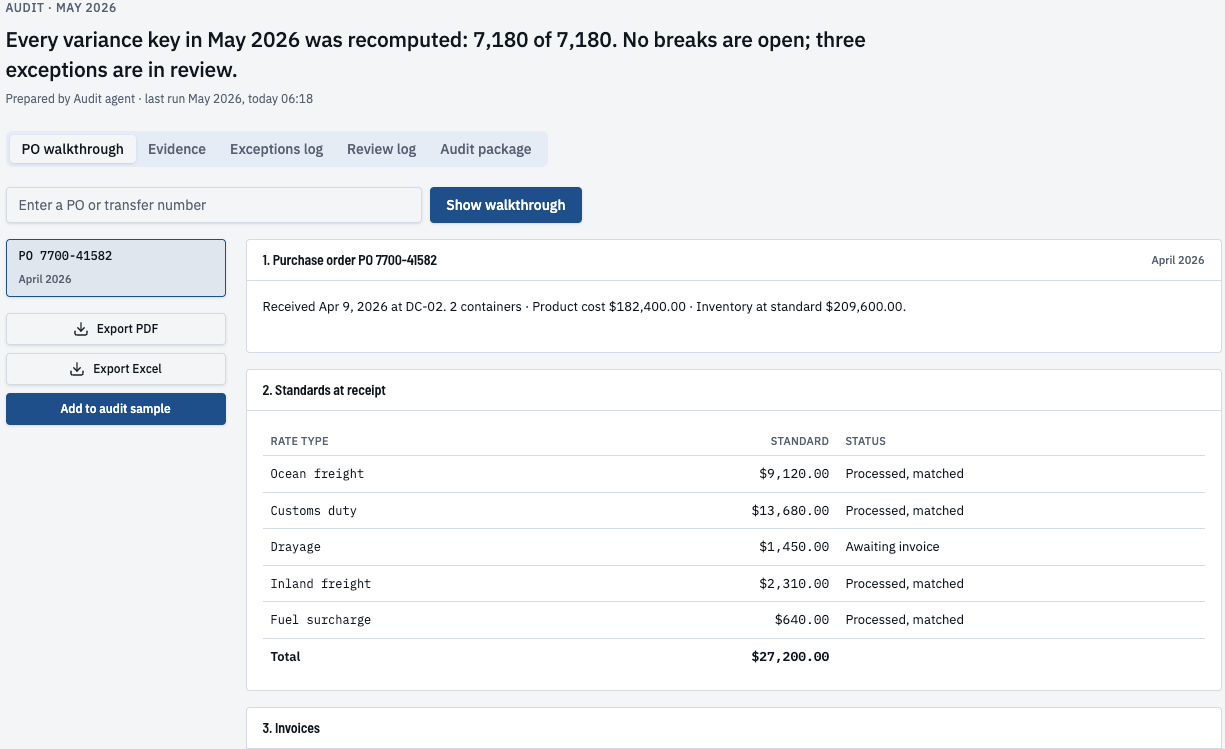
PO 7700-41582
Received Apr 9 · 2 containers
Inventory value at standard 209,600.00
| Component | Absorbed at standard | Invoiced | Variance | Status |
|---|---|---|---|---|
| Ocean freight | 9,120.00 | 10,460.00 | 1,340.00 | Matched |
| Customs duty | 13,680.00 | 13,410.00 | (270.00) | Matched |
| Drayage | 1,450.00 | n/a | n/a | Awaiting invoice |
| Inland freight | 2,310.00 | 2,880.00 | 570.00 | Matched |
| Fuel surcharge | 640.00 | 905.00 | 265.00 | Matched |
| Matched | 25,750.00 | 27,655.00 | 1,905.00 | |
| Awaiting invoice | 1,450.00 | n/a | n/a | |
| Total absorbed | 27,200.00 |
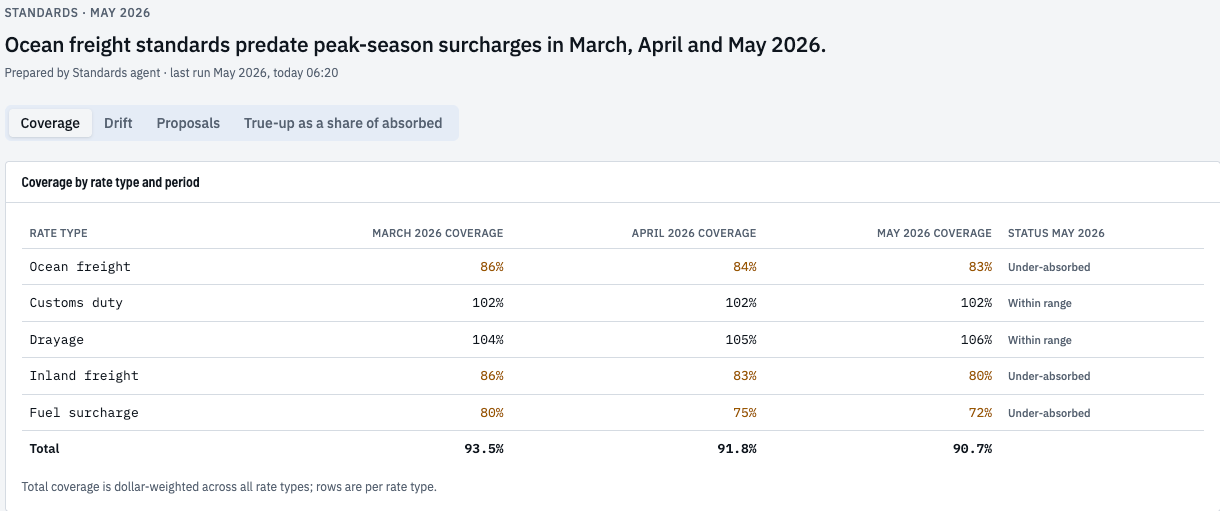
A peak-season surcharge of 670.00 per container on two containers. The standard predates the surcharge.
Legate is AI agents for the controller's office at companies that import, make or move physical goods. Its agents match freight, duty and overhead invoices to inventory receipts, compute variance against standard cost, explain the drivers, draft the entries, keep the audit evidence and watch the standards. Legate works with Oracle, SAP, Microsoft Dynamics 365 and NetSuite, and never writes to the ERP.
The month-end today
Why is the invoice always later than the inventory?
Booked at an estimate. Inventory is received at standard: product cost plus estimated freight, duty, tariff, fuel and handling.
Billed later, by container. Carriers, customs brokers and 3PLs invoice by shipment, not by PO line, often after the period has closed. ERP invoice matching was built for product invoices, so these have nothing to match against.
Reconciled by hand. Someone pulls receipts and invoices into Excel or Alteryx, works out what belongs to what, computes the variance, books the true-up and explains the swing. When the auditor samples a PO, the support is rebuilt from scratch.
The measure of a good standard is a small true-up. The job is to make the month-end entry as small as possible, and to know why it is not.
Tariff changes, peak-season surcharges and lane shifts now move actual landed cost faster than standards get reset, so the variance is larger and the explanation harder than it was two years ago.
Outcomes
What changes for the people who own the close.
Controller
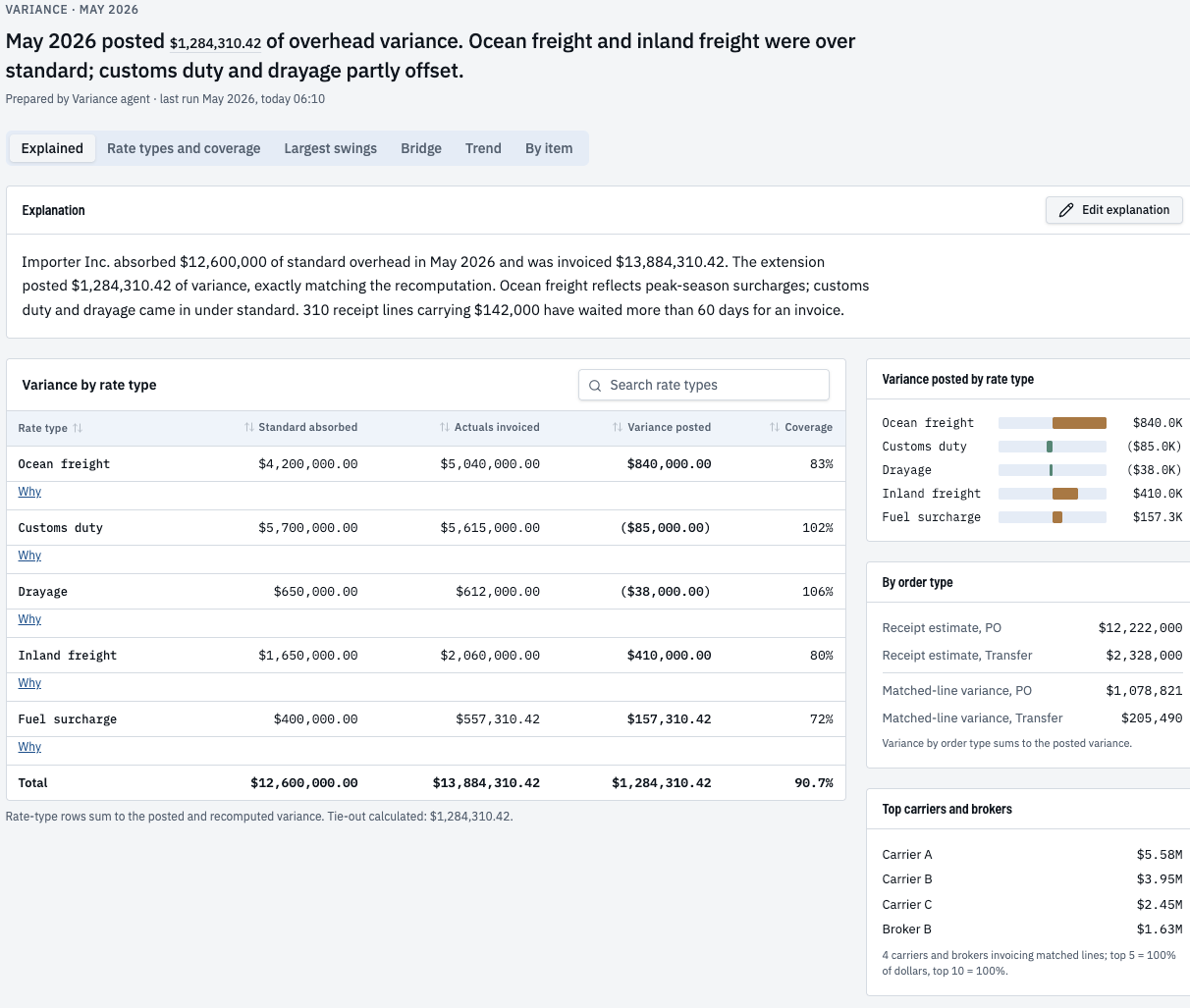
- The landed-cost variance every day, period-to-date, not after close.
- Every dollar explained: rate variance or unmatched invoice, by component.
- A ledger tie-out at zero, every period, with the proof attached.
- The true-up as a share of overhead absorbed, reported every period and driven down.
- Exception rate and close-schedule adherence, reported every period.
Assistant controller and cost team
- Start from the exception list: only large and aged items need you. PPV, freight, tariff and burden variances, one view.
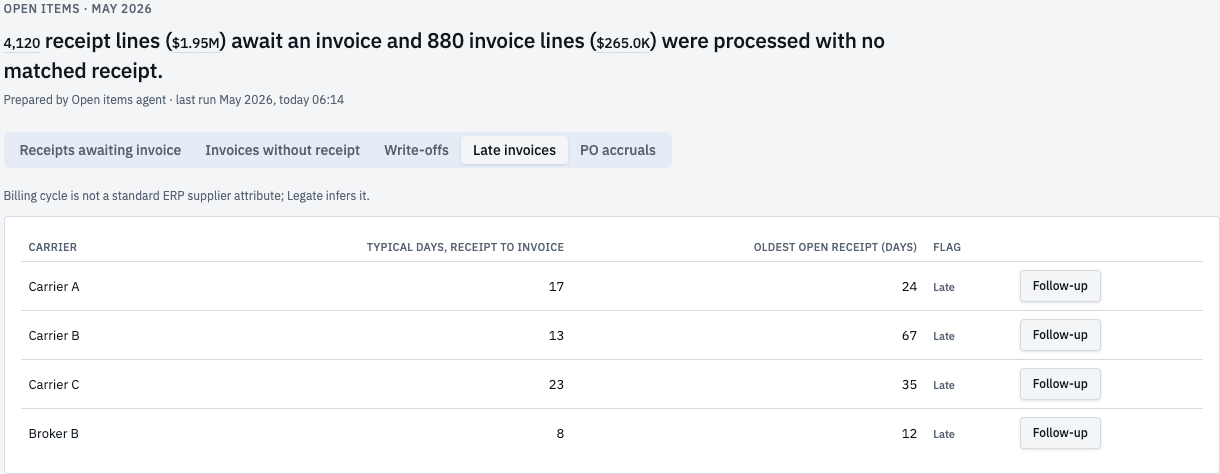
- Late carrier and broker invoices chased for you, by carrier.
- Every table downloads to Excel and uploads back.
- PO accruals from the PO and the receipt, drafted and reversing on day one.
Auditor
- Any sampled PO traced in one screen: absorbed, invoiced, variance, approver.
- Match rate, entries reviewed and invoice cycle time, reported for every period. Evidence requests answered from the screen.
CFO
- Freight, duty and overhead cost visible mid-month, so standards and supplier conversations happen before close.
Daily, period-to-date, monthly and quarterly views, on your fiscal calendar.
About half of a cost accountant's job stays with people: review, setting standards, physical counts, carrier negotiations. Legate does not touch those.
How it works
How does Legate explain a variance and draft the entry?
Each agent does one piece of the work a controller's team does today, and hands the result to a person. One engine underneath: ingest, match, roll forward, tie out, classify, explain, draft, approve, export. The numbers come from rules you can read. Nothing posts without a person.
Variance agent
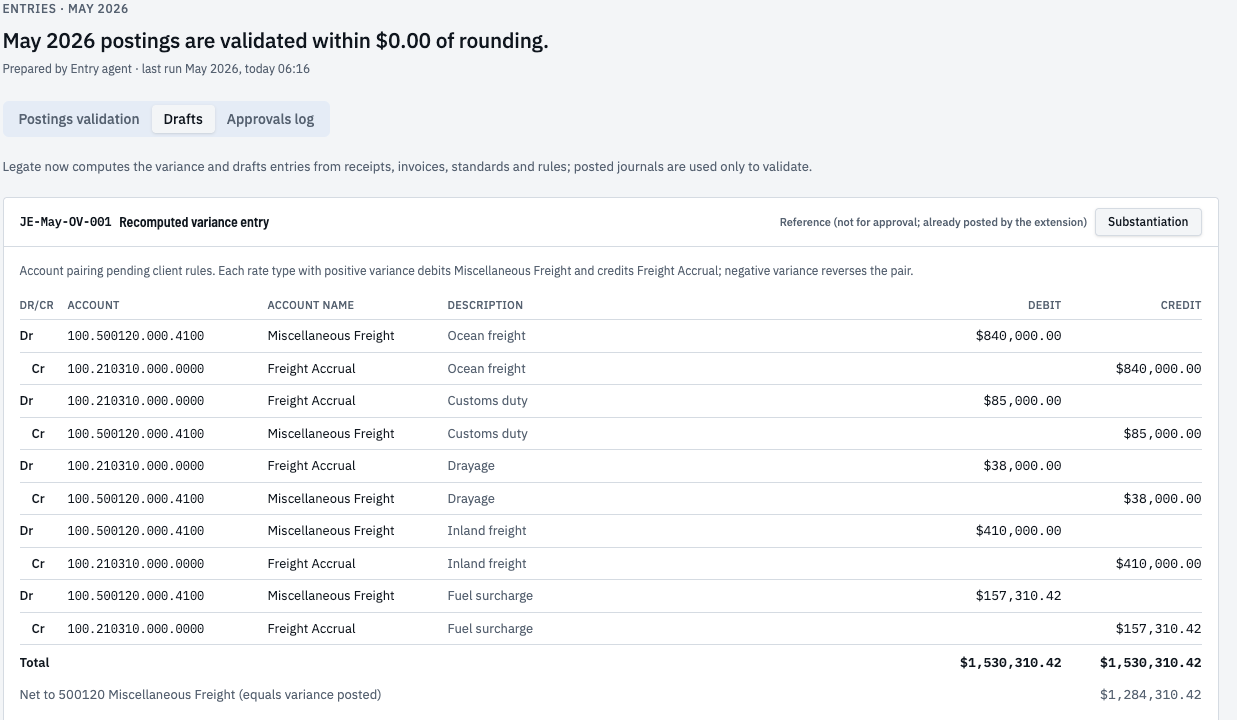
Matches every freight, duty and overhead invoice line to its receipt and PO, computes actual against standard including absorption, and explains the driver behind each dollar, split into rate variance and unmatched invoices.
Hands you:variance by component and driver, with the rows behind every number and the ledger tie-out.
Open items agent
Works the receipts still carrying an estimate and the invoices that matched nothing, chases late carrier and broker invoices by carrier, and prepares PO accruals from the PO and the receipt.
Hands you:an aged open-items list, follow-ups drafted, write-offs and accruals proposed for a person.
Entry agent
Drafts the true-up, the accrual and any correction with their support attached, and records the approval.
Hands you:debits, credits and the source rows, ready to approve. Your ERP posts it; Legate never does.
Audit agent
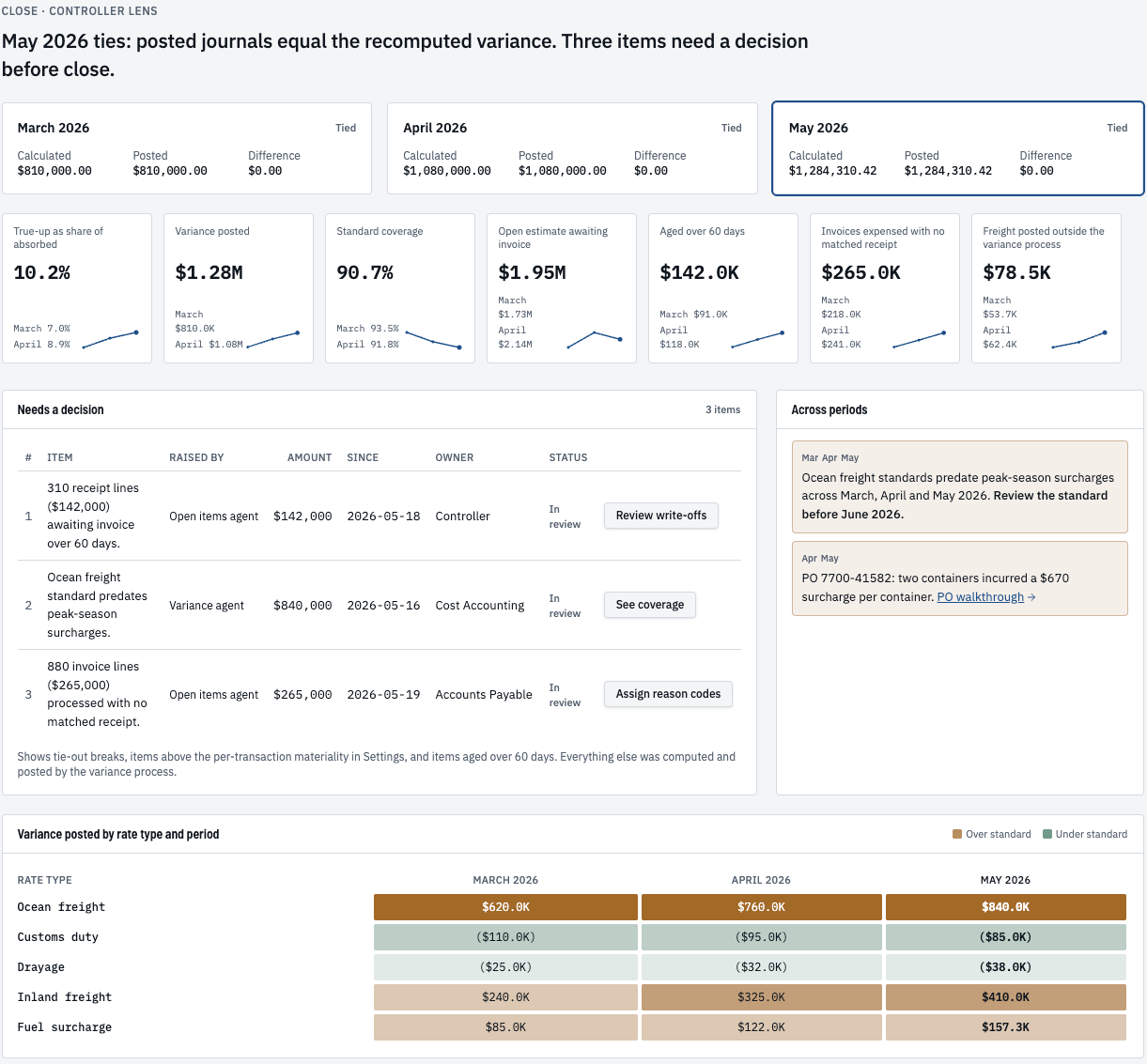
Traces any sampled PO in one screen and keeps the period's evidence, exceptions and review log.
Hands you:a PO walk-through for any sample, match rate, entries reviewed and a ledger tie-out at zero.
Standards agent
Watches actual against your standard rates by lane, component and period and proposes the rate change with the evidence.
Hands you:a proposed standard and the rows behind it. A person sets the standard.
Roll forward agent
Beginning balance, additions, reductions, ending, tied to the GL, for in-transit estimates, prepaids and fixed assets.
Hands you:every balance that feeds the ledger, with the difference explained.
From the container to the cost ledger. Your ERP posts; Legate never writes to it.
Every number on every screen opens to the filter, the rows and the sum behind it.
From the founders
"I spent years inside the CFO's office designing the systems that calculate landed-cost variance, and I ran the close they served. The integrator's build did the matching and the posting. The month-end still came down to one person, a spreadsheet, and three hours a day explaining the swing to five teams. Legate is the layer that was always missing: the explanation, the open items and the proof, done before anyone opens Excel."
Vinod Nallasivam, Co-founder
Suresh Nallappan, Co-founder, who built AI products for enterprise evidence and commerce for twenty years.
Walk-through
What does the auditor see when they sample a PO?
The screen your auditor asks for when they sample a receipt. Product cost, overhead absorbed at standard by component, the actual carrier and broker invoices against each one, and the variance, in one view. Export it for the audit file.
The product
Built around the close you already run.
Built around the close you already run.
Does Legate fit your close?
- You import, make or move physical goods and carry inventory at standard or landed cost.
- Import receipts carry freight, duty, tariffs, fuel or handling at an estimate, trued up later.
- Carrier, broker or 3PL invoices arrive after receipt, sometimes after the period closes.
- The variance analysis lives in Excel or Alteryx, or in a custom build plus a spreadsheet that checks it.
- Your auditor samples these entries and you rebuild the support by hand.
- You work in a SOX-controlled environment and answer evidence requests by hand.
- You accrue open purchase orders at month end and reverse them on day one.
- You are mid-ERP implementation, just went live, or run more than one ERP.
- You run Oracle, SAP, Microsoft Dynamics 365 or NetSuite.
Retailers, distributors and manufacturers all qualify.
The demo
See a month-end worked end to end. Thirty minutes.
What you'll see
- A full period worked from invoice match to draft entry.
- A PO walk-through, the way your auditor would sample it.
- Your questions answered by the two founders.
What we won't ask for
- No data from you.
- No system access.
- No commitment.
WHERE THIS GOES
Starts with the landed-cost variance. Grows across the controller's close.
Legate is built as an agentic platform for the controller's office: agents that complete whole workflows, composable tools underneath them, and a way to ask for any figure and get it back as a table, a chart or an Excel file. After the landed-cost variance come PO accruals, item-level variance and PPV, prepaids and the fixed-asset roll forward, every balance tied to the ledger and explained. The ERP keeps the general ledger; Legate substantiates the balances that feed it.
FAQ
Security
Your data, handled like audit evidence.
Legate keeps a copy of the extracts you share in a store that belongs to your company alone. It reads; it never writes back. Here is how Legate handles your data.
How your data is handled
- Files, not credentials. We do not ask for ERP logins or system access.
- Mutual NDA and a data processing agreement before any data moves.
- One isolated store per company, encrypted in transit and at rest, hosted in the US.
- Only the fields the variance needs. No bank details, no employee data.
- Deleted within 30 days when you stop using Legate, or on request at any time.
- Read-only connections to Oracle, SAP, Microsoft Dynamics 365 and NetSuite. No write-back.
- Tenant isolation: your data is never pooled or shared with another customer.
- TLS 1.2 or higher in transit, AES-256 at rest.
- Single sign-on (SAML), multi-factor authentication and role-based access.
- An audit log of every action, by every user and every agent.
- Every figure traceable to its source line.
- Your data is not used to train AI models, ours or any provider's.
- You set retention. Deletion on request, confirmed in writing.
- A published list of subprocessors.
Security questionnaire? Send it to hello@onlegate.com and we answer it in full, including SOC 2 timing.
Team
A finance-systems architect and a product builder.
Vinod Nallasivam
Co-founder, finance and delivery
Sixteen-plus years leading finance, supply chain and technology transformation for consumer, manufacturing and retail companies, inside the CFO's office. Has designed landed-cost variance solutions and run the month-end close they serve, along with procure-to-pay, cost and inventory accounting and the audit evidence behind them. Led multi-year programs valued at over $90M with cross-functional teams of 100-plus. Degree in computer science engineering; MBA in Strategy and Finance.
linkedin.com/in/vinodnallasivamSuresh Nallappan
Co-founder, product and technology
Builds zero-to-one products: in a startup, where speed is the constraint, and inside a large enterprise, where security and governance are. That is why Legate ships at startup pace with the controls a finance buyer expects. Co-founded PredioAI, an AI-native lease intelligence platform, and took it from startup to exit. At Nike, Senior Director of Launch Engineering and Bot Mitigation, and before that engineering founder of the China Digital Studio in Shanghai. Founding engineer at Exterro, from concept to Fortune 50 legal teams. MS Computer Science, USC.
linkedin.com/in/sureshnallaBook a demo
See Legate in action.
Thirty minutes with both founders. Nothing to install, nothing to share.
Or write to hello@onlegate.com